
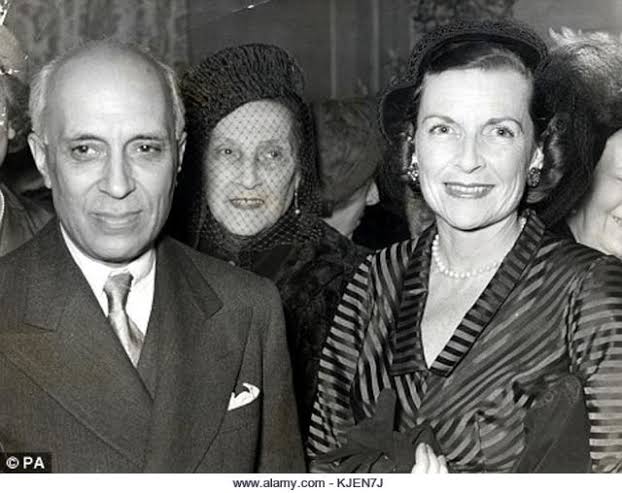
Edwina Mountbatten was the wife of last governer general of India Lord Mountbatten and she was a close friend of Pandit Jawaharlal Nehru.
When Edwina Mountbatten died prematurely in 1960, she was buried at sea. Indian Prime Minister Jawaharlal Nehru sent two Indian destroyers to cast a wreath of marigolds after her coffin and honour the departed lady. It is believed that the two remained close until her death and corresponded through letters.
The jury has always been out on whether the warm relationship between Jawaharlal Nehru and Edwina Mountbatten was platonic or physical. The supposed romantic relationship between Nehru and Edwina has unfortunately overshadowed Mountbatten’s legacy. After all, Mountbatten had a good relationship with Nehru (though apparently not quite as good a relationship as his wife shared with Nehru). So, what kind of love was it really?
“I mean a very deep love. The kind of love that the old knights of old had, a chivalric love really … Nowadays everybody assumes that it has to be a carnal love, but you can have just as deep an emotional love with two like souls in a way, people who really grow to understand each other, and to be able to listen to each other and to complement each other and find solace in each other”, said Pamela Hicks, the younger daughter of the Mountbatten’s in an interview with Karan Thapar in 2007. She said she does not believe Nehru and Lady Mountbatten had a sexual relationship but added “maybe everybody will think I’m being very naïve”.
When Thapar asked, “There was no tinge of jealousy or perhaps of hurt emotion (in Lord Mountbatten)?” she replied “No, because I think he trusted them both. And also, my mother was so happy with Jawaharlal, she knew she was helping him at a time when it’s very lonely at the pinnacle of power. It really is. And if she could help, and my father knew that it helped her, because a woman can, after a long marriage, and they had been over twenty five years together, a woman can feel perhaps frustrated, and perhaps neglected if somebody’s working terribly hard. And so if a new affection comes into her life, a new admiration, she blossoms and she’s happy.”
The interviewer probed even more: “But Panditji was a widower, he needed female affection. Your mother was alluring and beautiful. They were so close to each other. It would be natural for the emotional to become sexual”. But Mrs. Hicks refused to accept that the relation could have been sexual: “It could be, and maybe everybody will think I’m being very naive, but the fact that she had had lovers in the past, somehow this was so different, it really was. And the letters, I mean if you were deeply, physically in love, your whole letter would be about the other person and your need of them physically, and it would be that kind of love letter. These letters had an opening paragraph of tenderness, and the end would be also tender and romantic and nice like that, but three quarters of the letter was unburdening himself of all his worries and his disappointments or his hopes and all his idealism coming out for the extraordinary time of India at her rebirth in history and it is the history of India as an independent nation”.
The precise nature of Nehru’s relationship with Edwina has long been of interest to historians.
At a ceremonial Palace party before Elizabeth’s coronation in 1953, Edwina had turned up with Nehru, not her spouse – the handsome Lord Louis Mountbatten about whom it was once said that he could charm a vulture off a corpse. Pakistanis have always maintained that India had an unfair advantage because Nehru was apparently able to influence the viceroy through his wife. But they seem to be more in the nature of conspiracy theories than reality.
There are very often confusing and contrasting reports as to what exactly went on. The truth is we will never know. For the haters of Nehru, this builds into a wonderful smear campaign and an opportunity to create and share unspeakable jokes, and for the supporters, this is just trash talk.
So, again, what kind of love was it? At the time of her death in 1960, while still one of the world’s richest women, Edwina had no splendid possessions with her: only a pile of old letters on the bedside table. She must have been reading them when she died, for a few, having fluttered from her hands, were strewn across her bed. They were all from one man. Jawaharlal Nehru.
What Edwina had with Nehru was something she wanted to remember on her death bed.
 Factual Factory